Everything UK recruiters need to know about AI in recruitment — what works, what doesn't, and how to save 15 hours a week starting today.
What's in this guide
AI recruitment tools use artificial intelligence — typically large language models (LLMs) like GPT-4 and Claude — to automate the administrative tasks that take up 30-40% of a recruiter's working week.
Unlike traditional recruitment software that requires manual data entry and boolean search strings, AI tools understand natural language prompts. You describe what you need in plain English and the AI generates professional output — job descriptions, outreach messages, candidate assessments — in seconds.
For UK recruiters, the most valuable applications include:
Key stat: 55% of revenue-growing recruitment firms are already using AI embedded in their ATS, and 78% of revenue growers say AI is critical to their success. (Bullhorn GRID 2026)
Several factors have converged in 2026 to make AI recruitment tools essential rather than optional:
Applications are up 51%. The flood of applications means manual screening is no longer viable at scale. AI screening tools can process hundreds of CVs in seconds with consistent criteria.
AI adoption has passed the tipping point. 37% of organisations now actively integrate generative AI into recruiting (up from 27% in 2024). The question is no longer "should we use AI?" but "which AI tools should we use?"
The UK market is still in "education mode" — high-intent search terms like "AI recruitment tools UK" and "AI CV screening software" have very low keyword difficulty, meaning early adopters who build content authority now will dominate search traffic as the market matures.
Cost pressures are real. With 43% of firms expecting only modest economic improvement in 2026, protecting margins through automation is a competitive necessity.
The numbers are substantial and well-documented:
The bottom line: A recruiter who saves 15 hours per week has nearly two full working days returned. Over a year, that's the equivalent of adding 3 months of productive time — per recruiter.
See exactly how many minutes each AI tool saves you per task.
See the ROI breakdown →AI recruitment tools deliver measurable financial returns. Here are the most cited benchmarks from 2025-2026 research:
For a typical 10-person recruitment agency, moving from traditional tools to an all-in-one AI platform like Talent Forge can save over £108,000 per year in software costs alone — before factoring in the value of reclaimed recruiter time.
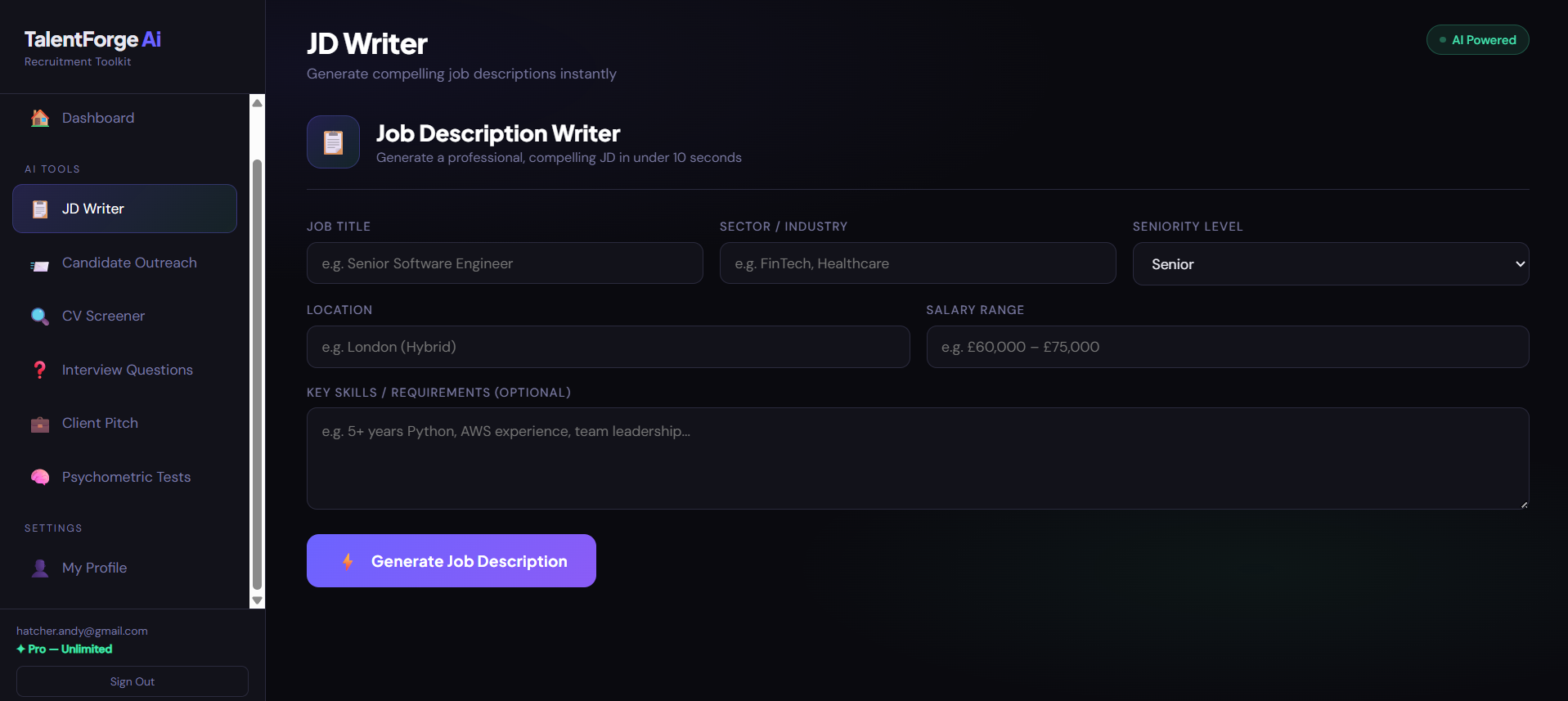
One of the highest-adoption, lowest-risk AI applications. Instead of spending 45-60 minutes drafting and editing a job description, describe the role in one sentence and get a fully-formed, SEO-optimised JD in seconds. Built-in bias checking removes gendered language automatically.
Generic templates get ignored. AI-personalised outreach that references a candidate's specific projects and skills gets 30-40% higher reply rates. Three-touchpoint sequences deliver 356% higher response rates than single emails.
The biggest time drain in recruitment. AI CV screening evaluates every candidate against consistent, bias-aware criteria. It produces a fit score, identifies strengths and gaps, and recommends whether to interview. Shortlist 20 CVs in the time it takes to read 3.
Pre-generated, structured question banks ensure every interview is thorough and fair. Generate behavioural (STAR), technical, situational and culture-fit questions with scoring rubrics — tailored to any role and seniority level.
Win more mandates with tailored pitch documents that position your agency as the obvious choice. Enter the client's sector, the role, and their challenges — get a professional, structured pitch in minutes instead of hours.
Industry-standard psychometric assessments — SHL-style scenarios, situational judgement tests and aptitude assessments — generated on demand. Proven to predict job performance better than interviews alone, without expensive licensing fees.
Talent Forge combines all 6 tools in one platform. Explore the full features →
AI in recruitment is powerful but has limits. Based on 2025-2026 practitioner data:
Best practice: Use AI to filter out mismatches, not to filter in the perfect candidate. Let AI handle the heavy lifting of admin so recruiters can focus on what they do best: building relationships and closing deals.
Getting started with AI recruitment tools is simpler than most people think. Here's a practical plan: